The Best Way To Understand Six Sections of a Credit Report
How to Understand Credit Report
The best way to understand a Credit report is to explore each section of credit report and understand nitty gritty of each section. In nutshell Credit report is a summary of consumer information on an individual person. The three credit reporting agencies namely Experian, TeansUnion and Equifax are in the business of accumulating consumer information on persons over the age of 14. Credit bureaus (TransUnion, Experian and Equifax) create profiles of individuals and keep updating their credit profiles to keep up to date. Below article gives full information on "How to Understand six section of a Credit Report".Now the question is how they keep tab on every persons credit profile. Every country has their own way of identifying their citizens. In America we have Social Security Number. This is unique number given to each person at the time of birth or for an immigrant on getting legal visa to work in America. Under this unique ID person can apply for bank account, credit card, rent apartment or open business etc. Each time person uses social security number to open the accounts be it at banks, credit cards, retail or apply for loan, mortgage loan the information is captured by each of these credit bureaus and updated against person's credit profile.

This collective consumer data becomes valuable for creditors, bankers, lenders, landlords and employers to judge on your credit trustworthiness. How you deal in your credit dealings with lenders, business, and financial institutions and how you manage your retail, utility accounts is also captured and updated on your credit profile. It becomes very important on part of a consumer to manage responsibly credit and ensure that there are no negative remarks on credit profile. Any negative remarks on your credit profile will derive out lenders and creditors and you will miss out on low interest rate offers on loans and credit cards. If credit profile is severally damaged then you will even have difficulty in getting a apartment to rent or simple debit or credit account get opened. Thus understanding Credit report becomes very important for a consumer.
For credit Bureaus to record your consumer information in a meaningful way. They have divided credit report into major six sections. Together a score evaluated on information present in these six sections derives a credit score, which gives lenders and creditors an opportunity to offer you with credit offers. The six sections making a credit report are given below:
The Credit Report sections are:
- 1. Personal Information
- 2. Summary of Accounts
- 3. Account History
- 4. Public Information
- 5. Inquiries
- 6. Creditor Contacts
Personal Loans Up To 35,000

Personal Information Section in a Credit Report
 |
| Personal Section |
Personal Information
This section provides information on your personal details. None of this information is used to evaluate your credit worthiness. No information from this section is used in evaluating your credit score. This section purely identifies you and provides your identity.Let’s say you have account with any of three bureau and you need to get report or login to their website. In case you don’t have secure password to login they will ask for personal details to verify your identity. Hence having your personal information correct in each of the bureau is very important.
The details of Personal section are as follows:
- 1. Name, 2. Date Of Birth, 3. Current Address, 4. Previous Address, 5. Employer Details
Account summary section in a Credit Report
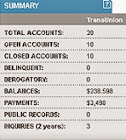
This is most important section of your credit report. Under this section a list of your accounts are shown with drill down details on how many are open, closed, and delinquent. Under this section also is reported your balance on each account, how much payment you make to each account. Any negative remarks, your public records are also listed here. All this information is captured under nine categories under this section.
Nine categories under your Summary section in Credit Report
- 1. Total Accounts, 2. Open Accounts, 3. Closed Accounts, 4. Delinquent, 5. Derogatory, 6. Balances, 7. Payments, 8. Public Records, 9. Inquires
Definitions of above nine categories.
Category name DescriptionTotal Accounts: Lists total accounts including open and closed.
Open Accounts: Under this category all opened accounts are listed.
Closed Accounts: Under this category all closed accounts are listed. Please note even if you close account they still remain for a specified amount of time on your credit reprot.
Delinquent: Under this category all accounts are listed which are past due (you fail to pay on time)
Derogatory: Under this category all accounts which are negatively impacted because of lenders reporting either on past due payments or foreclosure, bankruptcies etc.
Balances: Under this section amount you owe to lenders is listed.
Payments: Under this category the payments you are making to each account are listed.
Public Records: Under this section all your public record information is listed. Your public record information such as mortgage information, court records, county records etc.
Inquires Under this section inquires made by lenders and creditors are listed. Please note there are two types of inquires which are hard and soft. Soft inquires do not make any impact on your credit score . But hard inquires do make impact on your Credit Score. The inquiry's made by lenders to just check on your credit profile are considered as soft inquires. Any inquiry made by lender based on your application is considered as hard inquiry
Account History Section in Credit Report

Account History:Under this section are listed account names and detail history of each account. The major credit accounts reported under five categories. The five categories are as follows:
- 1. Real estate, 2. Installment, 3. Revolving, 4. Collection, 5. Others
Definitions of above categories
Real Estate: Under this category your first and second mortgage information is recorded. The information such as First and second loan, payment plan, remaining balance, missed payments etc.Installment Account: Under this category all accounts comprised of fixed terms with regular payments, such as a car, bike boat loans are covered.
Revolving Accounts: Under this category all your credit card accounts with variable payments are covered.
Collection Accounts: Under this category all collection accounts are reported. All accounts which have past due more than 120 days unpaid payments are reported here.
Other Accounts: Under these category miscellaneous details are added. This also covers financial details.
Each account is shown in details. The details which are shown on your credit report are Credit account number, Current balance, Account type, current pay status, payment paying status such as current, 30/60/90/120 late or account in collection. All these details are listed in horizontal line against each account.
Payment Symbols under Account History in Credit Report.
OK :- The "OK" status represents that payment on account was received before the due date.30 :- The "30" day status represents that payment was not received in 30 days after the due date was passed.
60 :- The "60" day status represents that payment was not received in 60 days after the due date was passed.
90 :- The "90" day status represents that payment was not received in 90 days after the due date was passed.
90 :- 120 The "120" day status represents that payment was not received in 120 days after the due date was passed.
150 :- The "150" day status represents that payment was not received in 150 days after the due date was passed.
PP :- The "PP" status represents that a agreement has been reached between creditors/lenders and borrower for payment plan.
RF :- The "RF" status represents that borrowers account has been turned to foreclosure process.
CO:- The "CO" status represents that either account was given to collection
To get more information on each account click on "more" link to drill down the account details. Once you click on "more" link the information displayed are account balances, limits, dates and shows payment history for last 7 years. Here is what you can expect to see once you click the link.
Past Due: This shows amount of payment which is overdue. In credit report it will show the past due amount.
High Balance: This shows in this account history when did you ever owed higher balance to lender. In case of credit card it will be the higher borrowing limit you ever hit and in case of mortgage it will be always initial borrowing loan.
Terms:
Limits: This shows how much you can borrow on account. You can't borrow above this amount limit.
Payment: This shows how much you are scheduled to pay on this account. Of course you can always pay your debt fast by making additional payments.
Opened: This shows from when this account is active.
Reported: The most recent activity on this account will be shown.
Responsibility: This shows who is responsible to repay the loan. Information will show either account is under an individual or co-signer.
Late Payments: This will show history of late payments made under different cycles such as 30, 60, 90 etc. Remarks General note on status of account.
Remarks: General note on status of account.
Public information section in a Credit Report

Public Information: Under this section of credit report includes publicly information available on you with county, city, court etc. This will cover judgments awarded against you or in your favor in civil court, state, federal. This will also cover tax liens and bankruptcies. All this legal information will be listed under this section.
Here is what you can expect to be shown under this section.
Bankruptcy: Anytime you had filed for bankruptcy to relive you from financial liability to run a business. This could happen either your business didn't go well or you are simply unable to pay.
Tax Lien: This could be due to not paying taxes for long period of time and then city, state or federal government filing tax lien on your personal or business account.
Legal Item: This is due to legal case judgment against you in a civil action.
Marital Item: This is simple case of divorce related judgment.
Financial Counseling: Many time's people loose control over their spending and fall into the debt trap. When person goes through a financial counseling to reduce the debt or pay in installment, the information is treated as public and recorded in Credit profile.
Financial Statement: When creditors/lenders file lien on a person's property. Usually this happens when creditor’s wants secure the loan by filing the lien on property.
Foreclosure: It is a process in which creditors takeover the property from owner because he has defaulted on account or simply has stopped paying the monthly installments.
Garnishment: This happens when court orders to hold some or all from persons wage to repay the debt owned to Creditors/Lenders.
Inquires Section in a Credit Report

Inquires on your Credit Profile
Inquires made by Creditors/Lenders on your Credit ReportThis section of credit report includes inquires made by business, lenders and creditors on your report and data is shown from last two years. Creditors/Lenders always scan peoples credit profile to see which profile suit for their credit offers. When they see person having storing credit profile and less or no debt, they will send credit offers in mail.
Please note there are two type of credit inquires. Hard and Soft inquires.
Hard Inquiry on your Credit Report - When creditors/lenders check on your credit profile based on your credit application it is considered as "Hard Inquiry".
Please note such inquires in large number impact your credit score. When will this happen, you are shopping for car/boat loan or for mortgage. You go to one lender to other lender, each of these lenders are going to access your credit report to check on your credit worthiness. All these inquiries are termed as hard inquiry.
Soft Inquiry on your Credit Report - Not on your credit application but a random check by creditors/lenders is considered as Soft inquiry. These type of inquires do not impact your credit score.
Creditors Contact Section in Credit Report
 Creditors Contact Information
Under Creditor’s contact section all the lenders, business and bankers name and address will be listed. These are the lenders with whom you have taken the loan or done business in past. You will also see the names of creditors who have made soft or hard inquires on your credit profile.
Creditors Contact Information
Under Creditor’s contact section all the lenders, business and bankers name and address will be listed. These are the lenders with whom you have taken the loan or done business in past. You will also see the names of creditors who have made soft or hard inquires on your credit profile.In this section you will see Creditors name, Address and their Phone numbers. In case you want to contact these lenders for any reason the addresses and phone numbers listed on right side of Creditor’s section should be used for communication.
Incase you liked the article, please share my blog with your choice of network.


